$0.00


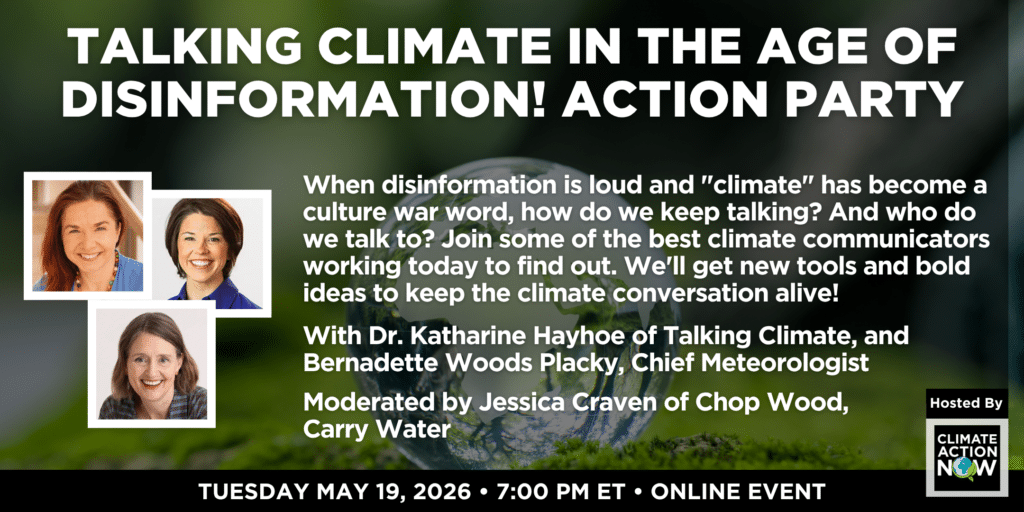
Featuring climate scientists and communications experts, the Talking Climate in the Age of Disinformation Action Party explored how everyday people can break through political polarization and fossil fuel industry misinformation. We were all reminded that using your voice is the most powerful climate action you can take.
We learned from Dr. Katharine Hayhoe, one of the world’s leading climate scientists and communicators, and Bernadette Woods-Placky, a climate communicator and Emmy-award winning meteorologist. Together, moderated by climate advocate Jessica Craven, they dismantled the myth that personal carbon footprint is the whole story, making the case that systemic change starts with conversation, community, and showing up for each other.
Participants also took action during the event using the CAN Carousel, an advocacy tool that allows people to contact political and business leaders in just a few clicks. Throughout the event, attendees emailed and called their elected officials, urging them to prioritize climate action. The group surpassed 400 actions by the end of the hour!
Watch a recording of the conversation (1 hour) or read a quick recap.
Recording
Quick Recap
Disclaimer: This is an auto-generated meeting summary from Zoom, offering a high-level overview of the discussion. Please note that it may not capture all details with perfect accuracy.
This was a Climate Action Now Action Party event featuring a panel discussion with Dr. Katharine Hayhoe and Bernadette Woods-Placky, moderated by Jessica Craven. The panelists discussed effective climate communication strategies, emphasizing that while personal carbon footprint reduction is important, the most powerful action individuals can take is using their voice to catalyze systemic change. They addressed how to engage people in climate conversations by connecting weather experiences to broader climate patterns, using plain language, and focusing on solutions rather than just scientific facts. The panelists explained that public opinion is the only effective counterweight to fossil fuel industry power and that even one voice can start momentum that builds into larger movements. During the event, participants took over 400 actions through the CAN Action Carousel platform, which allows users to contact elected officials on climate issues. Brett Walter, CEO of Climate Action Now, announced that action carousels are available free to any organization and promoted the organization’s Daily Dose of Climate Hope newsletter and membership opportunities.
Summary
Climate Action Now Action Carousel
Amber Ledbury, the Outreach Coordinator at Climate Action Now, welcomed attendees to the action party and explained how to use the CAN Action Carousel to take climate-focused actions, including contacting elected officials. Brett Walter, the CEO and founder, introduced a goal tracker and demonstrated how to access the action carousel via laptop or phone. The meeting transitioned to a panel discussion moderated by Jessica Craven.
The Disinformation We Need to Name
Katharine identified one of the fossil fuel industry’s most insidious tactics: deliberately shifting public focus onto individual carbon footprints to distract from the systemic changes actually needed. This strategy, she explained, wasn’t accidental — it was designed to make climate action feel like a personal failing rather than a collective responsibility. While personal choices matter, the real lever of change is collective voice, and public opinion remains the only effective counterweight to fossil fuel industry power.
Most People Are Already Worried — They Just Don’t Know What to Do
One of the most striking insights from the panel: the gap isn’t belief, it’s action. Katharine emphasized that most people are already worried about climate change — they simply don’t understand its personal impact on their lives or know how to address it. Bernadette reinforced this, pointing to evidence that climate conversations work when they’re connected to community experiences and daily life. The problem isn’t apathy. It’s that people haven’t been given the tools or the permission to speak up.
How to Actually Talk About Climate
Bernadette and Katharine shared concrete strategies for having climate conversations that land — even with skeptical audiences. Rather than leading with scary science or political framing, both speakers recommended connecting climate to things people already care about: weather they’ve experienced, energy bills, community health, and quality of life. Bernadette shared examples of effective entry points, from energy efficiency conversations at tailgates to linking flight delays to broader weather pattern changes. The key, they agreed, is plain language and a focus on solutions. Katharine also noted that many objections that sound scientific are actually rooted in solution aversion — a fear of having to sacrifice quality of life. Meeting people there, with constructive and practical answers, opens far more doors than debating the data.
You Don’t Have to Be an Expert
Perhaps the most liberating message of the evening: you don’t need a science degree to talk about climate. Bernadette encouraged attendees to simply share an article they found interesting, forward a webinar, or bring up something they heard recently. These small conversational moments build awareness and normalize climate as a topic worth discussing. Katharine demonstrated this live, role-playing a conversation about flight delays due to weather and showing how naturally it connects to the bigger picture. No jargon required.
One Voice Can Start a Movement
Change doesn’t require everyone at once. Bernadette reminded attendees that one voice, consistently showing up, can shift perspectives over time — as Katharine illustrated with the story of a UN scientist whose family came around through years of patient, relationship-first engagement. The goal isn’t to win an argument in a single conversation. It’s to plant seeds, maintain the relationship, and keep the door open.
Climate Is Every Issue
Katharine and Bernadette pushed back on the idea that climate is a niche concern. As Katharine put it, climate change isn’t a separate issue — it’s woven into nearly every top voter priority, from the economy to public health to national security. Bernadette added that framing climate through those interconnected lenses helps it rise in urgency without triggering the political defensiveness that the word “climate” sometimes carries. When people see climate as part of what they already care about, the conversation changes entirely.
Taking Action Together
Throughout the event, attendees didn’t just listen — they acted. Using the CAN Action Carousel, participants emailed Assembly members and called their representatives in real time, surpassing 400 actions before the hour was up. Brett Walter, CEO of Climate Action Now, reminded attendees that action carousels are available free to any organization, and encouraged everyone to subscribe to the Daily Dose of Climate Hope newsletter and consider becoming a CAN member to keep the momentum going.