$0.00


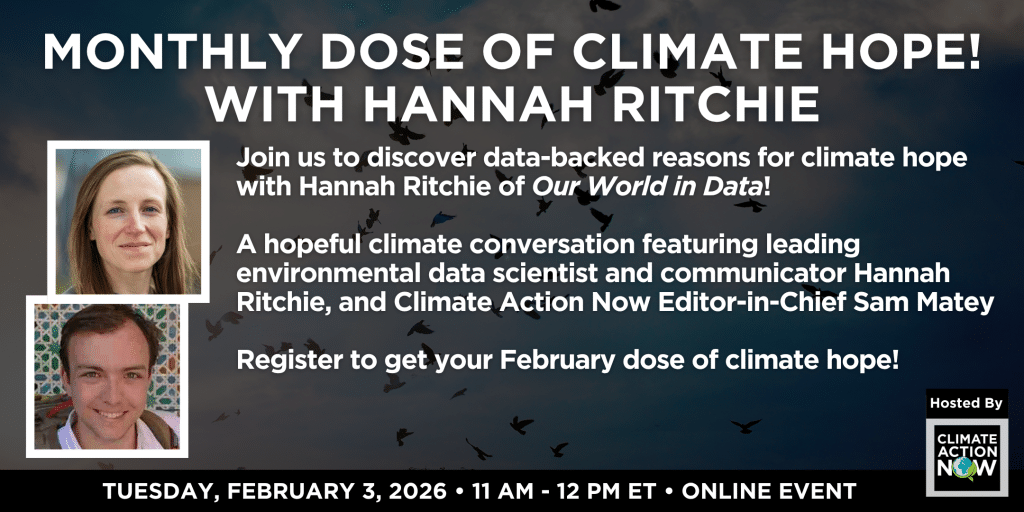
Our recent conversation with Dr. Hannah Ritchie of Our World in Data revealed the powerful, data-backed momentum behind humanity’s efforts to build a more sustainable future. We explored hopeful data trends, from the unprecedented acceleration of renewable energy and its direct impact on poverty reduction to remarkable gains in global food security and disaster resilience.
Watch a recording of the conversation (1 hour) or read a quick recap.
Recording
Quick recap
Disclaimer: This is an auto-generated meeting summary from Zoom, offering a high-level overview of the discussion. Please note that it may not capture all details with perfect accuracy.
The meeting was a discussion with Dr. Hannah Ritchie, of Our World in Data, about data-driven hope on climate and global development. Participants explored the transformative potential of renewable energy, trends in disaster resilience and food security, and strategies for effective public engagement. The discussion concluded with the introduction of new tools for climate advocacy and a call for support to expand their reach.
Summary
Solar Energy’s Global Impact
Sam and Dr. Ritchie discussed the rapid, cost-effective growth of solar power and its crucial role in addressing climate change. She highlighted that stable emissions in countries like China are linked to surges in clean power generation. The conversation covered the broader “electro-tech revolution,” including the potential for nations to leapfrog fossil fuel systems and the benefits of electrifying transport.
Energy Access and Disaster Resilience
The discussion highlighted the rapid adoption of solar panels in countries like Nigeria, underscoring its impact on human well-being. Dr. Ritchie used the example of Bangladesh’s improved cyclone warning systems to illustrate how enhanced disaster resilience can drastically reduce fatalities despite more severe climate events.
Climate Change, Food Security, and Population
Dr. Ritchie explained that while climate change poses risks, agricultural innovation has thus far increased global crop yields and calorie production. She addressed declining global fertility rates and a potential mid-century population peak, noting that dietary shifts toward plant-based diets may impact future food availability more than population size.
Addressing Global Food Inequality
The conversation noted overall improvements in the global food system but highlighted persistent challenges in sub-Saharan Africa, where lower crop yields and fast population growth create disparities. Dr. Ritchie stressed the need for innovations in drought-resistant seeds and climate-smart technologies in the region.
Renewable Energy as a Tool for Poverty Reduction
Dr. Ritchie explored how renewable energy, particularly solar, can drive economic growth and reduce extreme poverty by providing cheaper, accessible power. She emphasized the need for structural economic transformation in high-poverty regions and contrasted the improving cost-effectiveness of renewables with the static prices of fossil fuels.
Climate Action Advocacy Tool
Dr. Ritchie discussed public attitudes, noting the need to link climate action with other priorities like cost of living. Brett introduced the Action Carousel tool for mobilizing advocates and announced plans for a Democracy Action Dashboard. The team called for volunteers and financial support to distribute these tools to wider networks.