$0.00


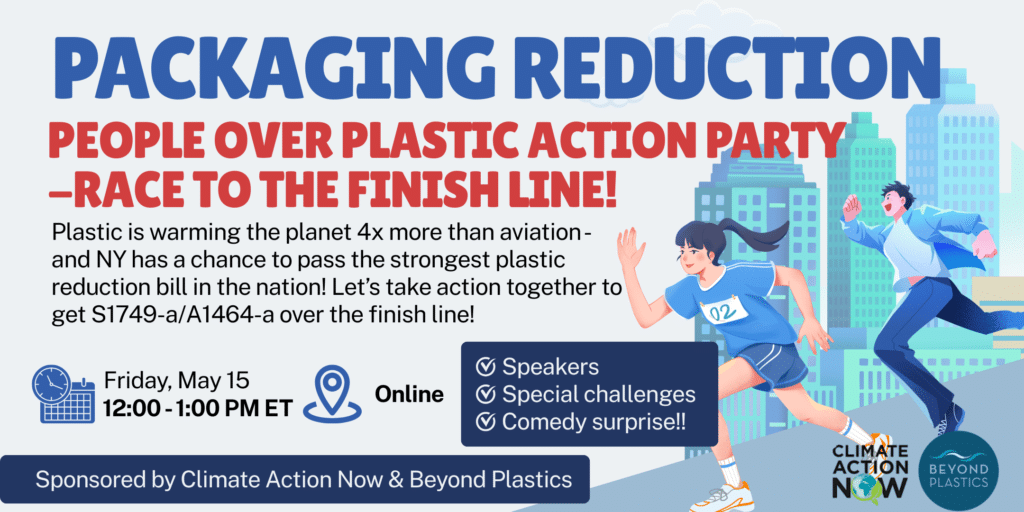
Featuring environmental justice advocates and community organizers, the People Over Plastic Climate Action Party explored the urgent need to pass New York’s Packaging Reduction and Recycling Infrastructure Act (PRRIA) and the devastating real-world toll of the state’s broken waste system.
We learned from Yvonne Taylor, founder of Seneca Lake Guardian and one of Grist’s top 50 climate leaders in the country, and Monique Fitzgerald, community advocate with the Long Island Progressive Coalition and the Brookhaven Landfill Action and Remediation Group. Together, they brought the human face of New York’s plastic and landfill crisis to life, from cancer clusters in the Finger Lakes to decades of environmental injustice on Long Island, and made the case for why reducing waste at the source is the only real path forward. Alexis Goldsmith, National Organizing Director for Beyond Plastics and a principal organizer on the New York Is Not Disposable Campaign, also walked attendees through the bill’s history and its most recent amendments, explaining what was won, what was lost, and why passing it this session remains critical.
Participants also took action during the event using the CAN App, an advocacy tool that allows people to contact political and business leaders in just a few clicks. Throughout the event, attendees emailed members of the Assembly Majority Caucus and called their own representatives, Assembly Speaker Hastie, and Senate Majority Leader Stuart Cousins, urging them to bring PRRIA to a vote. The group surpassed 1,000 actions by the end of the hour!
Watch a recording of the conversation (1 hour) or read a quick recap.
Recording
Quick Recap
Disclaimer: This is an auto-generated meeting summary from Zoom, offering a high-level overview of the discussion. Please note that it may not capture all details with perfect accuracy.
The People Over Plastic Climate Action Party brought together environmental justice advocates and community organizers to make the case for passing New York’s Packaging Reduction and Recycling Infrastructure Act. Panelists from the Finger Lakes and Long Island shared firsthand accounts of the health, economic, and environmental toll of living near landfills and incinerators, putting human faces on a statewide plastic pollution crisis. The discussion highlighted how New York’s broken waste system disproportionately burdens low-income communities and communities of color, while corporations profit and avoid accountability. Participants took real-time action using the CAN App, emailing Assembly members and calling legislators to urge a vote on this landmark bill — surpassing 1,000 actions by the end of the hour.
Summary
Climate Action Now Action Carousel
Amber Ledbury, Outreach Coordinator at Climate Action Now, welcomed attendees and introduced the event format, demonstrating the CAN App and explaining how participants could email and call their representatives directly through the app. Kaylee Beam, Director of Content at Climate Action Now, guided attendees through accessing the People Over Plastic campaign and set an initial goal of 200 actions for the hour. Participants earned points for completing actions, contributing to real trees planted through Climate Action Now’s programs.
Thirst for Power Screening
The first portion of the event concluded with a screening of the PBS documentary “Thirst for Power,” which explores the deep connections between energy, water, and human survival. The film highlights how water is essential throughout the energy supply chain—from extracting fuels to cooling power plants and generating electricity. The documentary also examines how growing water scarcity and climate change are putting pressure on energy systems around the world. As populations grow and energy demand increases, these intertwined systems must be managed more carefully to ensure both reliable power and sustainable water use. The screening set the stage for the panel discussion, which explored how communities, policymakers, and industries can address these challenges and build more resilient water and energy systems for the future.
The Bill and Where It Stands
Alexis Goldsmith provided an overview of PRRIA and its legislative momentum, noting that Assembly Speaker Hastie had just announced the bill would be conferenced — a significant step forward even as the state budget remained unfinished. She walked through the bill’s history, from its original introduction by Assemblymember Steve Engelbright with a 50% plastic reduction requirement, through 69 amendments that weakened but did not gut it. The current version still requires a 30% reduction in plastic packaging, 20% reuse, effective recycling infrastructure, a ban on chemical recycling counting as recycling, and prohibitions on entire classes of toxic chemicals including PFAS and phthalates. Municipalities would still receive funds to cover packaging waste costs.
Voices from the Finger Lakes
Yvonne Taylor described the daily reality of living near Seneca Meadows, New York State’s largest landfill, which processes 6,000 tons of trash per day. A community survey of over 700 residents within 10 miles of the landfill found that 26% reported someone diagnosed with cancer or heart disease, 27% reported asthma or other respiratory issues, and the area has been identified as a cancer cluster with lung cancer rates 30–35% higher than state and national averages. Beyond public health, Taylor explained how the landfill threatens the Finger Lakes’ $4 billion agricultural and tourism economy, and how PFAS-contaminated leachate is trucked across the state to communities in Buffalo, Watertown, and Amsterdam. She called on legislators to pass PRRIA, close permit loopholes, and deny Seneca Meadows’ proposed 47-acre expansion that would extend its operation by another 15 years.
Environmental Justice on Long Island
Monique Fitzgerald traced the origins of the Brookhaven Landfill — New York’s largest regional landfill serving 1.9 million households — to the deliberate blockbusting of North Bellport in the 1950s, which displaced white working-class residents and made the community a target for landfill siting in 1970. Now 172 feet tall and 192 acres wide, the landfill has only grown since, with the town contracting with Covanta (now rebranded as ReWorld) to accept incinerator ash alongside construction debris and other waste. Fitzgerald called out Covanta’s greenwashing tactics — community funding initiatives, facility tours, and campaign contributions — while noting the company has faced hundreds of DEC violations and settled for far less than what communities need for real infrastructure change. She urged legislators to act, saying the governor “owes” New Yorkers after climate rollbacks in the state budget.
Comedy Relief with Gail Tierney
Climate activist and comedian Gail Tierney offered a lighthearted break near the end of the event, delivering a comedy slideshow that poked fun at the slow pace of legislation, the quirks of the climate movement, and the brazen greenwashing of the plastics industry. The segment was a reminder that joy and humor have a place in this work — even when the villains are very real.