$0.00


Winter Storm Fern is shaping up to be one of the worst storms of the decade.
This severe winter storm has plunged more than 20 states across the country into bitter cold, with an estimated 230 million people expected to navigate record-low temperatures and record-high snowfall for at least another week. The extreme conditions have left over 1 million households without power, caused at least 30 fatalities, and are expected to cost the U.S. more than $100 billion when all is said and done.
It’s an extreme weather event, all right—and while the connection may not be immediately clear, it was undoubtedly made worse by climate change.
Here’s what we mean.
In general, global warming is bringing us warmer, milder winters. But it’s also destabilizing the polar vortex. As our oceans continue to warm and Arctic sea ice continues to melt, more and more heat is exchanged between the ocean and the air. The result is a weaker, stretched-out polar vortex, wavier jet stream, and greater evaporation, which sends cold Arctic weather—and a lot of precipitation—further south.
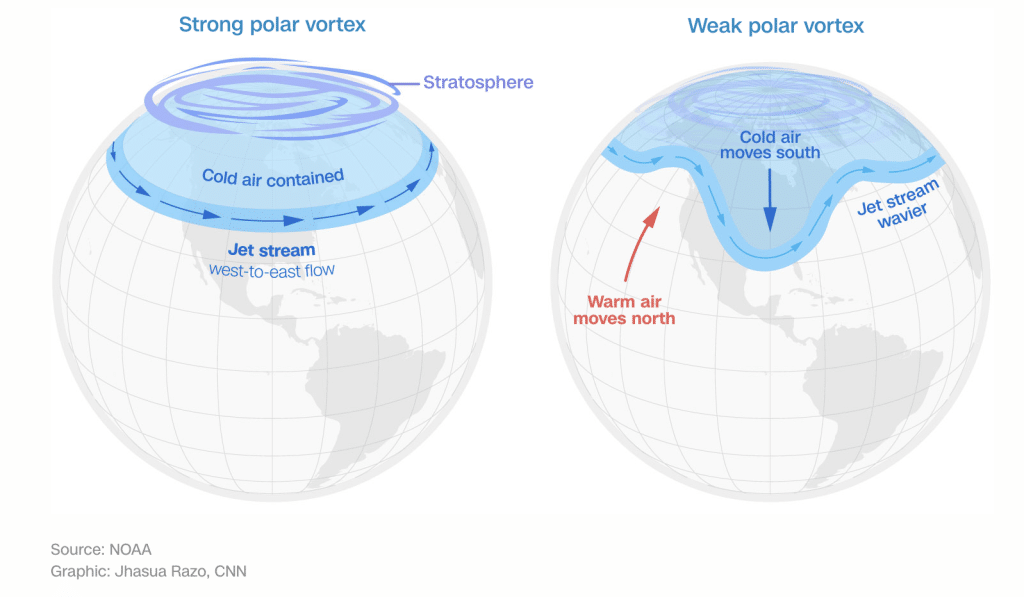
In other words, climate change isn’t just making winters warmer—it’s fueling the conditions that make severe winter storms like Fern more intense and more likely. And while the President and other climate deniers will continue to question global warming because of winter storms like Fern, major publications are past the point of entertaining their conclusions. TIME, CNN, and even CBS News are just a few examples of news organizations that have already reported that global warming and winter storms are not mutually exclusive.
The only thing they’re really missing is how fossil fuels fit into the picture.
As it stands, extreme cold and reliance on fossil fuels go hand in hand. Most homes in America rely on natural gas for heating, and many homeowners have gas- or propane-powered backup generators. No matter how much time passes, the prevailing assumption is that fossil fuels are inherently more reliable than renewables.
But even if that used to be the case, it isn’t anymore.
Consider Winter Storm Uri in 2021, which left more than 4 million households without power. According to RMI, coal and gas plants accounted for over 70% of the capacity of generators that experienced outages during that storm. It’s one of many examples of the particular risk that cold weather poses to fossil fuel supplies—and proof that the key to winter reliability isn’t continued reliance on fossil fuels, but continued investment in clean energy and battery storage, grid improvements, and innovative solutions like virtual power plants.
The federal government will undoubtedly continue its misguided efforts to curtail clean energy and put fossil fuels first, even if it risks locking us into a future in which severe weather events like Fern become annual rather than once-in-a-decade occurrences. It’s up to advocates like us to not only connect the dots between extreme weather and climate change but also to keep emphasizing the immense potential of the clean energy transition.
Join us!