$0.00


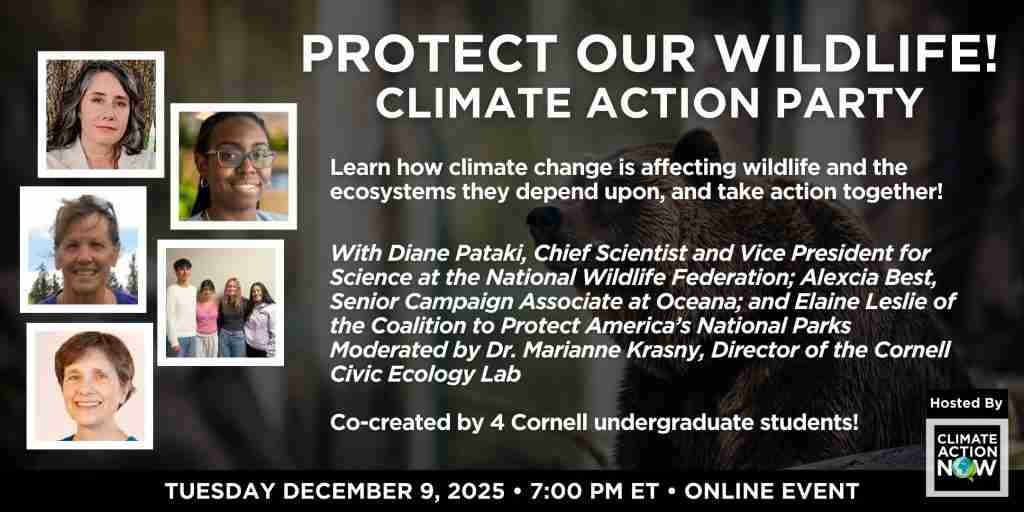
Planned in partnership with four Cornell students, the Protect Our Wildlife Climate Action Party was full of insights on how we can protect wildlife and the ecosystems they depend on!
We learned from Diane Pataki, Chief Scientist and Vice President for Science at the National Wildlife Federation; Alexcia Best, Senior Campaign Associate at Oceania; and Elaine Leslie of the Coalition to Protect America’s National Parks. At the same time, participants took action to protect wildlife, using the new CAN Action Carousel. The actions were created by the Cornell students as part of their capstone project!
Brett Walter, CEO of Climate Action Now, also shared about Climate Action Now’s new advocacy tool, the CAN Action Carousel. This new type of climate advocacy tool is available for free for any group of concerned citizens— any group can take action like how we did together during this event!
Watch a recording of the conversation (1 hour) or read a quick recap.
Recording
Quick Recap
Disclaimer: This is an auto-generated meeting summary from Zoom, offering a high-level overview of the discussion. Please note that it may not capture all details with perfect accuracy.
The meeting opened with introductions from Climate Action Now staff and a demonstration of their Action Carousel tool, which allows users to easily send messages to political and business leaders. A panel discussion featuring environmental experts explored challenges and strategies in wildlife conservation, focusing on the need for transformative environmental policies, renewable energy transitions, and the importance of community engagement in conservation efforts. The panel concluded by emphasizing the need for strong civic engagement and collective action to protect wildlife and combat climate change, with attendees encouraged to use the CAN Action Carousel to advocate for a sustainable planet.
Summary
Climate Action Now Action Carousel
Liz Bridgwater, the Director of Outreach at Climate Action Now, introduced the event and explained the purpose of the CAN Action Carousel, which allows participants to send messages to political and business leaders with just three clicks. She demonstrated how the system works by sharing her screen, highlighting its ease of use and the opportunity to earn points that result in real trees being planted. Liz then introduced Kaylee Beam, the Director of Content, to guide participants on how to start taking action during the event.
Wildlife Protection Campaign
The meeting began with Kaylee Beam, Director of Content at Climate Action Now, introducing the evening’s campaign focused on protecting wildlife, and explaining how participants could access and use the action carousel. She highlighted the integration of the carousel with the Climate Action Now app and provided instructions for its use. The Cornell University students involved in the campaign introduced themselves and their actions, which focused on various environmental topics such as watershed management, marine policy, and ecosystem protection. The panel discussion was then introduced, featuring Dr. Diane Pataki, Dr. Elaine Leslie, Alexcia Best, and moderator Dr. Marianne Krasny.
Wildlife Conservation Strategies and Challenges
The panelists discussed challenges and strategies in wildlife conservation. Diane highlighted the need for transformative environmental policies and emphasized the importance of state and local conservation efforts, mentioning the Recovering America’s Wildlife Act as a key legislative priority. Alexia shared successful messaging strategies for ocean conservation, focusing on the universal appeal of the ocean and its wildlife. Elaine reflected on changes in U.S. wildlife management over her 50-year career, noting a shift in the National Parks from mission-oriented conservation to a focus on visitor use, and emphasized the need for continued funding for inventory, monitoring, and habitat restoration.
Renewable Energy for Wildlife Conservation
The panelists discussed the importance of transitioning away from fossil fuels to protect wildlife and combat climate change, emphasizing the role of states in expanding renewable energy sources. Diane highlighted the need for local community engagement in clean energy projects and addressing misinformation. She also spoke about the potential for urban areas to play a significant role in conservation.
National Conservation Strategy Discussion
The group discussed conservation efforts and the need for a cohesive national conservation plan in the United States, with Elaine emphasizing the importance of addressing habitat fragmentation and climate change at a landscape level. They highlighted the lack of a comprehensive national conservation strategy and the need to integrate both cultural and natural resource management. The discussion concluded with a question about how public attention to charismatic species influences policy funding and support, and how the conversation could be reframed to elevate lesser-known species that maintain biodiversity.
Conservation Challenges for Invertebrates
The panel discussed the challenges of gaining public support for invertebrate and less charismatic species conservation. Diane highlighted that public engagement often focuses on charismatic species despite the critical role of invertebrates in ecosystems. Alexcia emphasized the importance of storytelling and working with ecological influencers to increase visibility for less-known species. Elaine stressed the need for early education and youth involvement in conservation efforts, citing successful programs like the National Park Service’s anniversary initiative. The panel agreed on the importance of connecting ecological relationships, such as the link between bird populations and insect declines, to engage the public in broader conservation efforts.
Climate Policy and Community Empowerment
The panel discussed the need to revamp and update policies to ensure sustainability and adaptability in the face of climate change. They highlighted the importance of incorporating human dimensions into policy-making and addressing issues such as invasive species and habitat loss. Alexcia emphasized the role of Indigenous communities in conservation efforts and the need for increased funding and partnerships. Diane stressed the importance of protecting democracy as a prerequisite for effective wildlife protection. The panel concluded by discussing the need for strong civic engagement and the empowerment of local communities in conservation efforts.