$0.00


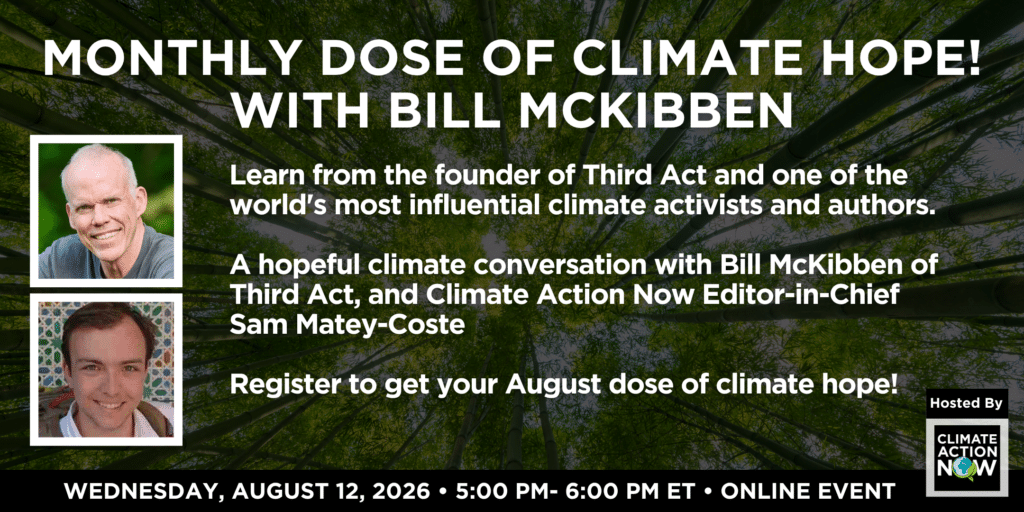
Our recent conversation with Bill McKibben, founder of Third Act and co-founder of 350.org, explored how the global transition to renewable energy is reshaping not just our climate future but the balance of power, peace, and independence worldwide. We discussed why the rapid electrification and solarization of the planet may be the largest human undertaking in history — and how it is already improving lives, from solar microgrids in remote communities to balcony solar panels newly legalized across ten U.S. states this year. Bill and interviewer Sam Matey-Coste traced how clean energy weakens fossil-fuel-dependent regimes while strengthening local resilience and democratic possibilities. Above all, they returned to a people-powered theme: that organizing, voting, and grassroots pressure remain the decisive force in accelerating the transition.
Watch a recording of the conversation (1 hour) or read a quick recap.
Recording
Quick recap
The meeting was a discussion with Bill McKibben and Sam Matey-Coste about the global shift to renewable energy and its benefits for the climate, energy independence, and peace. Bill framed the planet’s rapid electrification and solarization as the biggest human undertaking in history — an opportunity for global cooperation and a way to loosen the grip of fossil fuels that have fueled conflict and propped up authoritarian regimes. Sam highlighted how clean power enhances freedom and local development, especially where communities are gaining access to electricity, electric vehicles, and solar microgrids for the first time. The conversation turned to the political barriers slowing clean energy in the United States, and closed on the electoral organizing needed over the coming months, alongside new free services from Climate Action Now to help groups scale their climate efforts.
Disclaimer: This is an auto-generated meeting summary from Zoom, offering a high-level overview of the discussion. Please note that it may not capture all details with perfect accuracy.
Summary
The Biggest Undertaking in Human History
Bill described the worldwide shift to solar and wind as the largest project humanity has ever attempted — bigger than any war or moon landing, and unusual in its capacity to unite rather than divide. He and Sam explored how abundant, cheap clean energy can deliver essentials like healthcare, cooling, and connectivity to communities that never had reliable power. Beyond the climate benefits, they argued, the transition offers energy independence and a shared global project capable of bringing people together across borders.
Clean Energy Is Now the Resilient Choice
Solar and wind, paired with battery storage, have quietly become more reliable than the fossil-fuel systems they replace. Bill and Sam pointed to recent geopolitical shocks — disrupted oil flows through the Strait of Hormuz, drone strikes on Russian energy infrastructure — as reminders of how vulnerable fossil-fuel supply chains remain. Electric technologies like EVs, heat pumps, and induction cooktops, they noted, are simply better: more efficient, safer, and cheaper to run than the combustion-era systems still lingering in most homes and grids.
A Better World Is Already Being Built
From electric trucks in China to electric aircraft in Rwanda to free daytime solar electricity in Australia, Bill and Sam catalogued a clean-energy future that is already arriving in pockets around the world. Solar farms, they added, can even boost biodiversity, supporting pollinators and offering farmers better returns than industrial agriculture. The technology works and the benefits are real — what remains is the task of adopting it widely and quickly enough to matter.
The Obstacle Isn’t Technology — It’s Politics
Bill was direct about the American picture: clean energy here is being held back not by engineering limits but by political opposition and regulatory barriers, even as other countries race ahead. He criticized federal moves to block clean energy development while ceding ground to competitors like China. The fight, in other words, is now a political one — and the next several months of electoral organizing will help determine how much leverage the climate movement can regain.
People Power Accelerates the Transition
The most hopeful thread ran through the whole conversation: change of this scale happens because people make it happen. Balcony solar going from legal nowhere to legal in ten states in a single year is the product of persistent, people-powered advocacy — not inevitability. Bill closed on the coming election season and the need to organize, while Sam pointed to Climate Action Now’s monthly Balcony Solar actions as a way to keep the pressure on. The lesson of the series holds: action, sustained and collective, is what bends the arc toward a livable future.