$0.00


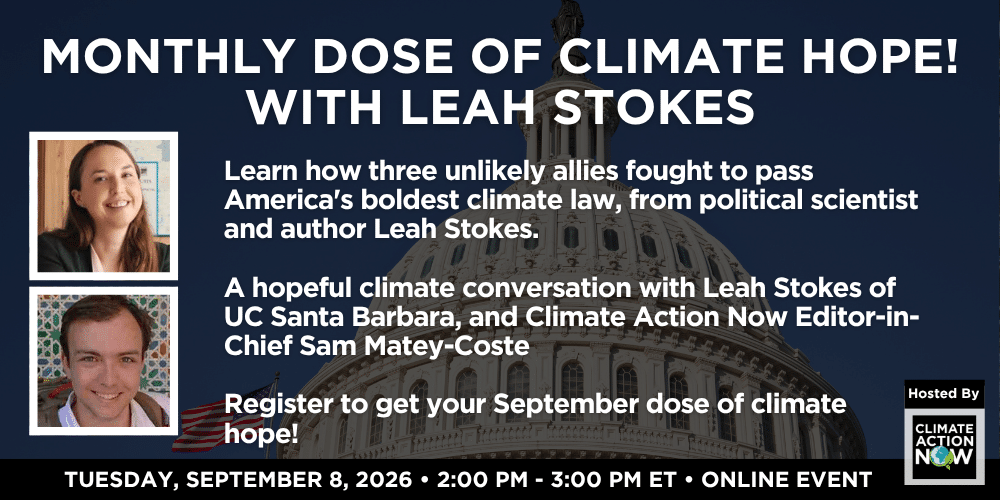
Our recent conversation with Leah Stokes, political scientist and Anton Vonk Associate Professor of Environmental Politics at UC Santa Barbara, explored the improbable path that led to the passage of the Inflation Reduction Act, the largest climate investment in U.S. history. We discussed how a fractured coalition regrouped to pass the law with exactly 50 Senate votes in 2022, and how, despite losing some consumer-facing provisions since then, the law’s largest pieces have proven remarkably durable — already sparking more than 500 new factories across roughly half of the country’s congressional districts. Leah also shared why she believes real climate progress comes not from individual carbon footprints, but from a “carbon wave” of people joining together to change the systems around them.
Watch a recording of the conversation (1 hour) or read a quick recap.
Recording
Quick recap
The meeting was a discussion with Leah Stokes, political scientist and one of the architects behind the Inflation Reduction Act, in conversation with Climate Action Now’s Sam Matey-Coste. Participants explored how the 2022 law came together despite a 50-50 Senate, what has and hasn’t survived the political attacks since, and how everyday advocacy — especially phone calls to elected officials — continues to shape policy outcomes. The conversation closed on a hopeful note: even under a hostile administration, coalitions of everyday people, local organizers, and quietly supportive Republican lawmakers are keeping the clean energy transition moving forward.
Disclaimer: This is an auto-generated meeting summary from Zoom, offering a high-level overview of the discussion. Please note that it may not capture all details with perfect accuracy.
Summary
From Political Miracle to Policy Feedback
Leah reflected on the improbable path that got the Inflation Reduction Act passed in 2022 with exactly 50 Senate votes, crediting a broad, years-long coalition rather than any single dealmaker. She explained “policy feedback” — the idea that a law’s benefits can reshape the politics around it, making repeal harder over time, much like Obamacare’s popularity protected it from rollback.
Retiring the “Carbon Footprint,” Embracing the “Carbon Wave”
Leah argued that the carbon footprint concept, popularized by fossil fuel industry marketing, wrongly shifts responsibility for a systemic problem onto individuals. Her new book proposes an alternative: the “carbon wave,” the idea of people joining together to change the machines and systems around them — from home heating to city vehicle fleets — rather than focusing solely on personal behavior.
What the Inflation Reduction Act Kept, and What It Lost
Since 2022, consumer-facing tax credits for EVs, heat pumps, and rooftop solar have been repealed. But Leah pointed out that the law’s largest provisions — corporate tax credits that funded over 500 new manufacturing factories across roughly half of U.S. congressional districts — have mostly survived, because they created jobs and investment that even opposing lawmakers were reluctant to lose.
Republicans Are Quietly Defending Clean Energy
Leah described a growing, if under-the-radar, pattern of Republican lawmakers privately protecting clean energy investments in their districts even while publicly avoiding climate rhetoric. She pointed to accountability campaigns funded by the clean energy industry that helped unseat lawmakers who tried to gut IRA tax credits, a sign the industry is beginning to flex real political muscle.
Finding Purpose in the Work Ahead
Closing the conversation, Leah acknowledged the scale of the challenge — from stalled EV incentives to the global race with China’s clean tech manufacturing — but framed the work itself as a source of meaning, not despair. Real change, she said, comes from people joining together in movements, and that collective effort is itself the antidote to hopelessness.