$0.00


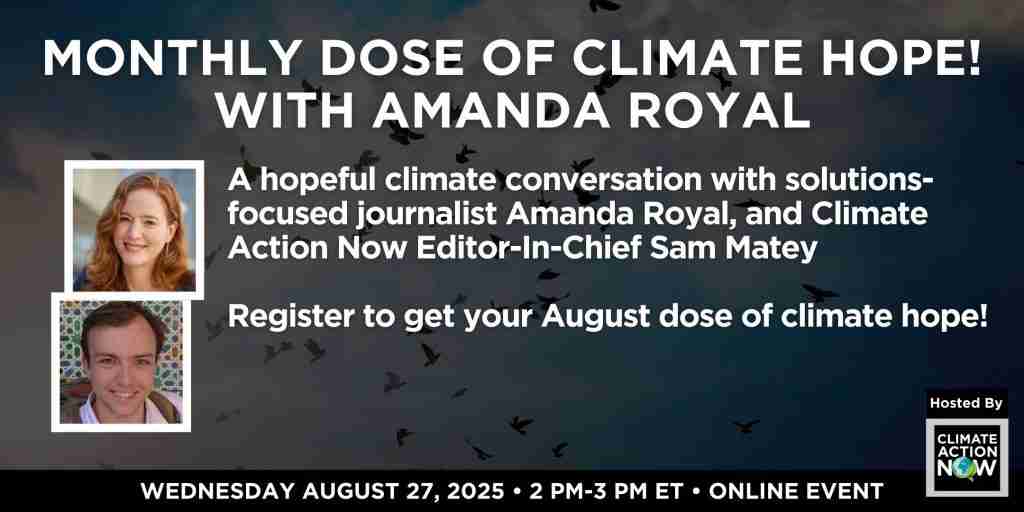
Our August Monthly Dose of Hope event was full of insights on hopeful conservation wins and a discussion of how Indigenous forest management strategies can reduce wildfire risk!
Climate Action Now Editor-In-Chief Sam Matey-Coste interviewed Amanda Royal, a solution-focused journalist and author of Earth Hope.
Watch a recording of the conversation (1 hour) or read a quick recap.
Recording
Quick Recap
Disclaimer: This is an auto-generated meeting summary from Zoom, offering a high-level overview of the discussion. Please note that it may not capture all details with perfect accuracy.
Quick recap
The meeting began with introductions and a demonstration of the Climate Action Now app before transitioning into a discussion about environmental journalism and success stories with Amanda Royal. The conversation explored various conservation efforts and innovations, including the Yurok tribe’s land restoration work, the Karuk tribe’s role in prescribed burning practices, and the Fix Our Forests Act legislation. The discussion concluded with an examination of forest management strategies and the challenges of changing public perceptions about fire in forest management, while also announcing upcoming Climate Action events.
Take Action
Liz Bridgewater, the director of Outreach at Climate Action Now, introduced the event and encouraged participants to share their locations and favorite local plants or animals. Kaylee demonstrated how to use the Climate Action Now app to take action by contacting decision-makers and earning points towards tree planting. The event then transitioned into a live interview with Amanda Royal, author of the Earth Hope newsletter, focusing on environmental success stories and innovations in fire technology.
Positive Environmental Reporting: A Shift
Sam and Amanda discussed the overwhelming negativity in news media and its impact on public perception of environmental issues. They explored how conflict-based headlines and media business models prioritize negative stories, often overlooking positive environmental news and solutions. Amanda highlighted the success of conservation efforts, such as the return of humpback whales to New York Harbor due to fishing regulations, and emphasized the importance of highlighting policy solutions and human achievements in environmental journalism. They agreed on the need to shift the conversation towards positive, serious news and solutions-based reporting to engage audiences and inspire action.
Julia Platt’s Fight for Monterey Bay
Amanda shared the story of Julia Platt, a marine biologist who fought against discrimination in the 1930s to protect a section of Monterey Bay. Despite facing legal challenges and physical barriers, Platt’s efforts led to the creation of a marine reserve that eventually helped restore the local ecosystem. The protected area allowed sea otters, which were believed to be extinct in California, to thrive, and today there are 3,000 sea otters in the Monterey Bay ecosystem.
Yurok Tribe’s Land Restoration Efforts
Sam and Amanda discussed the Yurok tribe’s efforts to restore their land and wildlife in Northern California. The tribe used carbon credits to buy back land and successfully reintroduced California condors, which are now the farthest north in North America. Amanda highlighted the tribe’s cultural significance of the condor as a symbol of balance and renewal. They also touched on the Yurok’s resilience and the importance of teaching accurate history about Native American tribes in schools.
Karuk Tribe’s Fire Management Practices
Amanda and Sam discussed the Karuk tribe’s role in regaining their traditional rights to set controlled fires, which has become an important practice in modern conservation efforts. Amanda explained how the Karuk tribe, with support from organizations like the Nature Conservancy, has become experts in implementing prescribed burns, which are now recognized as an essential tool for forest management and restoration. They highlighted how native American practices have been increasingly validated by science, revealing the significant role these practices played in shaping North American ecosystems. The conversation emphasized the importance of integrating traditional ecological knowledge with modern conservation strategies to address issues like wildfire management and biodiversity conservation.
Forest Management Bill Discussion
Sam and Amanda discussed the Fix Our Forests Act, a bill currently in Congress that aims to streamline land management practices, particularly prescribed burning and thinning, by exempting them from certain environmental regulations like NEPA. They explained that while the bill has divided some environmental groups, it actually represents a positive step forward in allowing more effective forest management, especially given the increased risk of wildfires due to climate change. Amanda highlighted that the bill would create fire sheds and councils to involve local communities and tribes in management decisions, and noted growing support from various organizations including tribes, Cal Fire, and The Nature Conservancy.
Effective Forest Management Strategies
Amanda and Sam discussed the importance of thinning and prescribed burns in managing forests to reduce the risk of severe wildfires. They highlighted that thinning plus prescribed burns is the most effective approach, as supported by scientific studies and environmental organizations. Amanda shared her personal observations of successful forest management projects, emphasizing the need to educate the public about the benefits of these practices. Sam mentioned ongoing political debates and potential technological innovations to scale up forest management efforts.
Reimagining Forest Fire Narratives
The discussion focused on the challenges and opportunities in changing public perceptions about fire in forest management, with Amanda and Sam exploring how to shift cultural narratives around Smokey the Bear and prescribed burns. Amanda emphasized the importance of personal stories and long-term perspectives in engaging people with environmental issues, while Sam highlighted the complexity of forest management policies and the need for nuanced communication. The conversation concluded with Liz announcing upcoming Climate Action events and Sam mentioning the release of a recording of the discussion.