$0.00


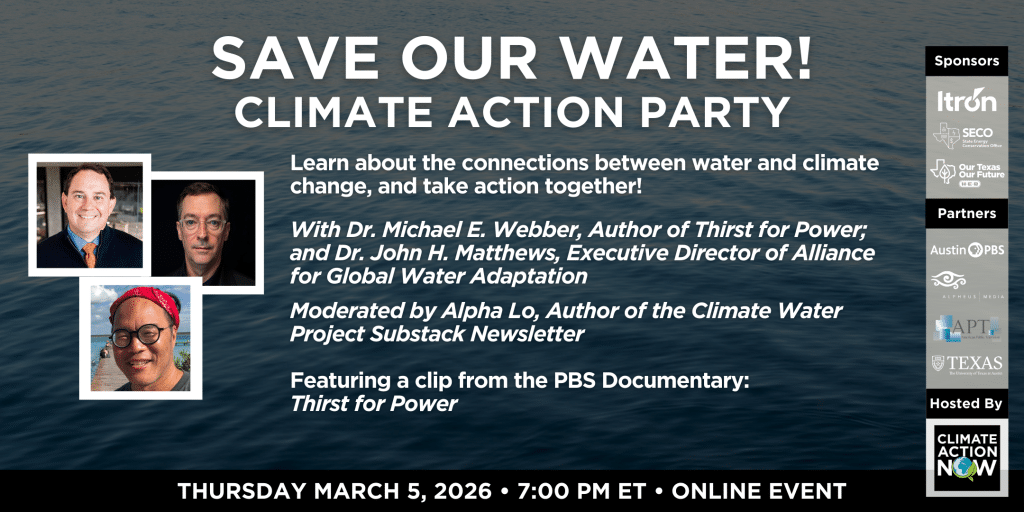
Featuring experts in climate, water, and energy, the Save Our Water! Climate Action Party explored the critical interconnections between the systems that power our world and sustain life
We learned from Dr. Michael Webber, Professor of Mechanical Engineering and author of Thirst For Power, and John Matthews, Executive Director and co-founder of the Alliance for Global Water Adaptation. Together, they unpacked the complex relationship between water and energy systems—from how thermal power plants rely heavily on water to how renewable energy sources like wind and solar can dramatically reduce water use. This event also featured a special screening of the Thirst for Power documentary.
Participants also took action during the event using the CAN Action Carousel, Climate Action Now’s new advocacy tool that allows people to contact political and business leaders in just a few clicks. Throughout the event, attendees sent messages urging stronger climate and energy policies while learning about the water-energy nexus and the challenges ahead.
Brett Walter, CEO of Climate Action Now, also shared updates about CAN’s Save the Planet subscription , which enables individuals to plant trees, support solar energy development in the Global South, and protect the Amazon rainforest starting at $9.95 per month.
Watch a recording of the conversation (1 hour) or read a quick recap.
Recording
Quick Recap
Disclaimer: This is an auto-generated meeting summary from Zoom, offering a high-level overview of the discussion. Please note that it may not capture all details with perfect accuracy.
The Climate Action Now Save Our Water! Action Party focused on the critical interconnections between water and energy systems. Panelists explored how modern energy production depends heavily on water resources and how renewable energy sources like wind and solar offer significantly more water-efficient alternatives. The discussion also highlighted emerging challenges, including the massive water and energy demands of AI data centers and the growing need for resilient water infrastructure in a changing climate. Participants took real-time action using the CAN Action Carousel while learning from experts about solutions and opportunities for civic engagement.
Summary
Climate Action Now Action Carousel
Amber Ledbury, Outreach Coordinator at Climate Action Now, welcomed attendees and introduced the event format, beginning with an icebreaker inviting participants to share where they were joining from and their favorite body of water they hope to protect. She demonstrated the CAN Action Carousel, a simple tool that allows participants to send messages to decision-makers in just a few clicks.
Kaylee Beam, Director of Content at Climate Action Now, then guided attendees through how to access the Action Carousel and encouraged them to participate in the water and energy-focused campaign during the event. Participants earned points for completing actions, which contribute to real trees being planted through Climate Action Now’s programs.
Thirst for Power Screening
The first portion of the event concluded with a screening of the PBS documentary “Thirst for Power,” which explores the deep connections between energy, water, and human survival. The film highlights how water is essential throughout the energy supply chain—from extracting fuels to cooling power plants and generating electricity. The documentary also examines how growing water scarcity and climate change are putting pressure on energy systems around the world. As populations grow and energy demand increases, these intertwined systems must be managed more carefully to ensure both reliable power and sustainable water use. The screening set the stage for the panel discussion, which explored how communities, policymakers, and industries can address these challenges and build more resilient water and energy systems for the future.
Energy-Water Nexus Challenges Discussed
Alpha introduced two panelists: Michael Webber, a professor of mechanical engineering and former Chief Technology Officer at Energy Impact Partners, and John Matthews, Executive Director and co-founder of the Alliance for Global Water Adaptation. John discussed the energy-water connection, highlighting its importance and the challenges faced by countries like Brazil in managing water resources for energy production, agriculture, and other sectors. He emphasized the need to understand and address the complex trade-offs between energy production and water availability, especially in the context of climate change.
Climate-Resilient Energy and Water Systems
The discussion focused on the interdependencies between water and energy systems, with Michael and John highlighting how current infrastructure was built for past climate conditions rather than future projections. They explained that extreme weather events, including droughts and floods, pose significant vulnerabilities to power generation and water supply systems, with Michael noting that Texas’s energy system was not designed for current weather patterns. John introduced the concept of “Deep Uncertainty” in climate prediction, explaining how traditional planning methods based on historical data are no longer effective, and shared examples of how water levels at major dams like Hoover Dam and Kariba Dam have been declining, threatening energy production and regional development.
AI Data Centers’ Water and Energy Challenges
The discussion focused on the significant water and energy consumption of AI data centers, with John and Michael explaining how these facilities, particularly in arid regions like Arizona and Phoenix, are straining local water resources and electrical grids. They highlighted that a single computer rack can consume as much power as a Walmart superstore, with water cooling requirements further exacerbating the issue. Michael mentioned his work on a documentary about AI energy and water consumption, and both speakers agreed that while AI has the potential to help develop solutions for water management in the future, it currently presents a major challenge to water resources.
Water Use in Energy Production
The group discussed the water usage and environmental impacts of different energy production methods, with Michael explaining that while all energy forms use water, wind and solar are the least water-intensive, followed by natural gas, while coal and nuclear power plants are very water-intensive for cooling purposes. John highlighted real-world examples of water-related challenges with energy production, including France’s nuclear power plants nearly running out of cooling water and Norway’s hydropower generation being affected by changing snowpack and river flows. The discussion concluded with Kaylee announcing that the group had reached their 300-action goal, encouraging participants to continue taking action before the hour’s end.
Nature-Based Water Management Solutions
John discussed nature-based solutions for water management, particularly focusing on California’s flood and managed aquifer recharge system which has successfully created new groundwater storage. He explained how this approach could be applied in other regions facing similar challenges, such as the Andes and Himalayas, reducing the pressure on water systems and energy consumption. John also highlighted the importance of riparian wetlands in China and the US, which serve as natural storage systems for water during the dry season, helping to meet the needs of large urban areas like Shanghai.
Climate Action Now Initiatives
Brett Walter, the founder and CEO of Climate Action Now, acknowledged the panelists and attendees for their engagement in discussing the critical issue of water and climate change. He highlighted the importance of the topic and thanked the panelists for their dedication to finding solutions. Brett also introduced Climate Action Now’s initiatives, including their newsletter “Your Dose of Climate Hope” and the “Save the Planet” subscription service, which allows individuals to contribute to tree planting, carbon reduction, and the protection of the Amazon rainforest. He encouraged attendees to stay hopeful and continue advocating for climate action, mentioning their upcoming event featuring Kevin Chou, co-founder of Bright Saver, who is working to bring balcony solar to the United States.